Executive Summary
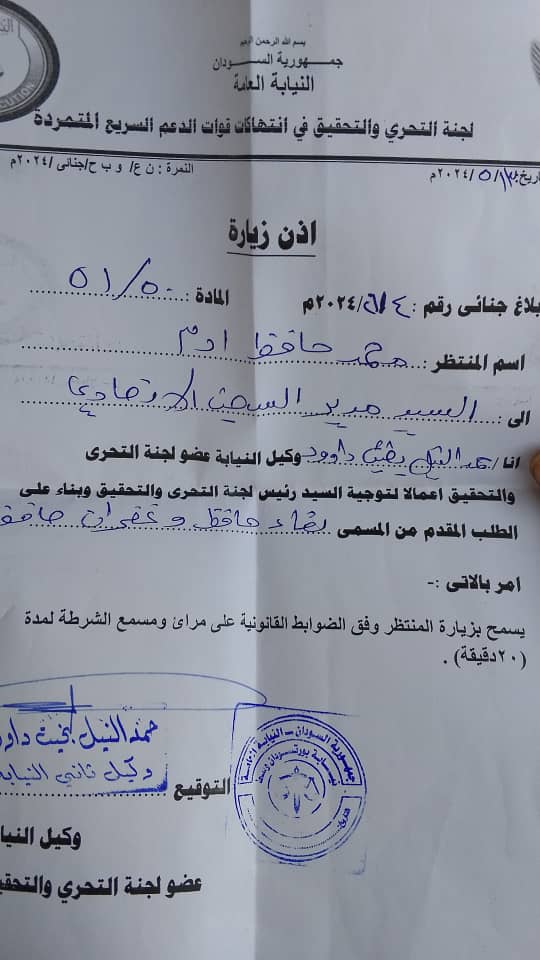
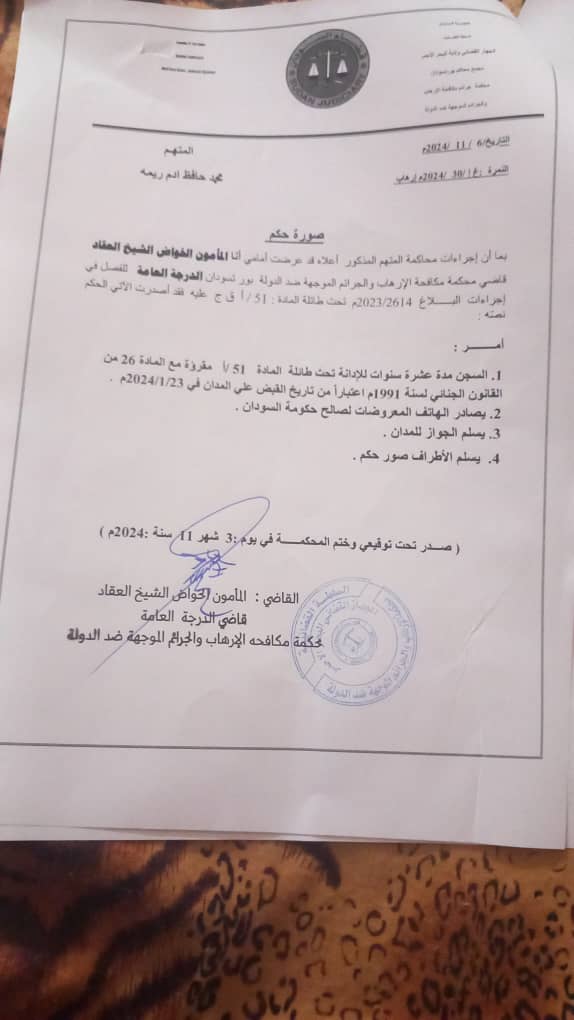
This report documents the case of Sudanese citizen Mohamed Hafiz Adam Rima, who was arrested in January 2024 in the city of Port Sudan Read Sea State subsequently convicted under Article (51) read with Article (26) of the Sudanese Criminal Act of 1991, on charges related to aiding the Rapid Support Forces (RSF) and waging war against the State.
Information and documents reviewed by the Darfur Victims Support Organization (DVS) indicate that the case was marred by gross violations of due process and fair trial standards, including:
Arbitrary arrest;
Incommunicado detention;
Allegations of torture and coercion during interrogation;
Reliance on tribal affiliation and traditional attire as presumptive evidence of guilt;
Refusal to permit an independent forensic examination of digital evidence;
Denying the defense the opportunity to present substantive arguments;
Reliance on circumstantial and speculative conclusions rather than direct forensic evidence.
This case raises serious concerns regarding the exploitation of counter-terrorism and state-security laws in Sudan to target civilians based on their tribal background or political suspicion amid the armed conflict that has been ongoing since April 2023.
I. General Background
Since the outbreak of the armed conflict in Sudan on April 15, 2023, between the Sudanese Armed Forces (SAF) and the Rapid Support Forces (RSF), the country has witnessed a widespread deterioration in human rights and the rule of law, particularly in cases linked to the conflict, regional ties, and tribal affiliations.
In eastern Sudan, specifically in Port Sudan—which has served as the temporary administrative and political capital for the Sudanese authorities—there has been a surge in arrests and security crackdowns targeting civilians belonging to certain Arab tribes originating from the Darfur region. These actions are frequently driven by suspicions of affiliation with or sympathy for the RSF.
In this context, the case of Mohamed Hafiz Adam Rima stands out as one of the most alarming. It reflects clear indicators of the politicization of justice, an overly broad interpretation of terrorism and treason offences, and the weaponization of cultural appearance and tribal identity as implicit grounds for conviction.
II. Profile of the Victim
Mohamed Hafiz Adam Rima is a Sudanese civilian who belongs to an Arab tribe originating from the Darfur region. For several years, he lived in the Kingdom of Saudi Arabia, working like thousands of Sudanese expatriates who left the country in pursuit of better economic opportunities.
According to information obtained by the Organization from his family and defense counsel, Mohamed had been outside Sudan for approximately five years prior to the outbreak of the war and was never involved in any military or political activity. Mohamed returned to Sudan in January 2024 via Port Sudan Airport due to urgent family and humanitarian circumstances, following a severe traffic accident involving his two sisters that required their urgent medical relocation—a fact confirmed by his family and medical documents later presented to the court.
III. Arrest and Detention
Upon his arrival in Port Sudan, Mohamed was apprehended by the Joint Security Cell and taken to an undisclosed detention facility. According to statements from his family and defense team:
- He was detained for an extended period without any contact with his family;
He was subjected to torture and ill-treatment;
He was subjected to sleep deprivation;
He was subjected to physical assault and humiliation; Some of his statements were extracted under coercive conditions.
Furthermore, his personal mobile phone was confiscated and searched. This was followed by subsequent allegations of tampering with digital evidence, alongside the court’s refusal to subject the phone to an independent, impartial forensic examination despite formal requests submitted by the defense.
Trial and Charges
The case was brought before the Anti-Terrorism and Crimes Against the State Court in Port Sudan, where Mohamed was charged under: Article (51) of the Sudanese Criminal Act of 1991 (Waging war against the State); - Read in conjunction with Article (26) (Criminal abetment/assisting).
According to court documents, the prosecution and the court relied heavily on:
Personal photographs showing the defendant wearing the “Kadmol”* (a traditional headwrap); - Telephone messages and chat logs;
- The timing of his entry into Sudan;
- Interpretations inherently tied to his tribal affiliation.
In November 2024, the court found him guilty and sentenced him to ten years in prison. Subsequently, the Red Sea State Court of Appeal reduced the sentence to five years while upholding the conviction.
Alarming Indicators of Violations of Justice
- Targeting Based on Tribal Identity
The facts indicate that Mohamed’s tribal background played a pivotal role in his suspicion and prosecution. Information received by the Organization reveals that the initial complaint was fundamentally linked to discussions and perceptions regarding his tribal lineage, driven by the social and political profiling that associates certain Darfurian Arab tribes with the RSF. This pattern of profiling poses a grave threat to the principle of equality before the law and risks turning ethnic or tribal identity into a baseline for criminal suspicion. - Criminalization of Cultural Appearance
The court implicitly relied on photos showing Mohamed wearing the “Kadmol”, a traditional garment historically widespread across vast regions of Sudan, West Africa, and North Africa. The Organization believes that using traditional attire as incriminating evidence or an indicator of military affiliation sets a dangerous precedent, especially considering:
- The widespread use of the Kadmol long before the war;
- Its cultural and social utility completely detached from military contexts;
- The absence of any legal text criminalizing its wear.
This raises profound concerns about the criminalization of cultural identity and its automatic conflation with political or military alignment.
- Violation of Fair Trial Guarantees
Defense documents highlight several procedural violations, including:
- The court’s refusal to allow the defense to conduct an independent forensic analysis of the phone;
- The abrupt closing of the defense’s case without an explicit request from the defendant’s counsel;
- Heavy reliance on circumstantial and speculative inferences;
- The failure to present conclusive, direct evidence proving participation in combat operations or organizational membership.
The defense also raised the issue of confessions and statements being extracted under duress, which casts serious doubt on the admissibility and legality of the evidence used to secure the conviction.
- Tampering with Digital Evidence
The case raises troubling questions regarding the integrity of the digital evidence presented against the accused, particularly following the refusal to grant an independent forensic examination. Allegations have surfaced regarding the insertion and removal of content from the phone, combined with a total lack of transparency regarding the protocol used for data extraction and analysis. The Organization maintains that denying the defense access to independent technical validation severely undermines the right to a defense and erodes the credibility of the judicial proceedings.
. Dimensions of the Case in the Current Sudanese Context
This case unfolds at a time when the Sudanese arena is witnessing noticeable political and military shifts. This includes the release of former combatants and the public appearance of figures and attire associated with the war within official institutions, alongside a decline in official rhetoric against certain appearances that were previously used as grounds for accusation. Conversely, civilians like Mohamed Hafiz Rima continue to serve harsh sentences based on inferences tied to appearance, affiliation, and suspicion—raising deep concerns over selectivity and inequality in the administration of justice.
International Legal Framework
The Darfur Victims Support Organization notes that the facts of this case constitute prima facie violations of numerous international standards, including:
- The right to liberty and security of person;
- The prohibition of arbitrary arrest;
- The prohibition of torture and cruel, inhuman, or degrading treatment;
- The right to a fair trial;
- The presumption of innocence;
- The right to an adequate defense;
- The right to equality and non-discrimination;
- The right not to be criminalized on the basis of cultural or ethnic identity.
These rights are firmly guaranteed under: - The International Covenant on Civil and Political Rights (ICCPR);
- The African Charter on Human and Peoples’ Rights (ACHPR);
- The Convention Against Torture (CAT);
- The Basic Principles on the Independence of the Judiciary and Fair Trial Standards. The Recommendations and Appeals by the DVAO
The Darfur Victims Support Organization urgently calls for:
- Opening an independent, transparent judicial review into the case of Mohamed Hafiz Adam Rima.
- Investigating allegations of torture and ill-treatment suffered during detention.
- Subjecting all digital evidence to an independent, impartial forensic examination.
- Ensuring that tribal affiliation or cultural appearance is never utilized as grounds for criminalization.
- Respecting fair trial standards and fully guaranteeing the rights of the defense.
- Enabling human rights organizations and the media to monitor the case freely and without restriction.
- Releasing all individuals arbitrarily detained on tribal, regional, or political grounds in the absence of direct forensic criminal evidence.
- Halting the misuse of counter-terrorism legislation to restrict fundamental rights and freedoms or to target civilians.
Conclusion
The case of Mohamed Hafiz Adam Rima exposes a deep crisis facing the justice system in Sudan during this period of conflict, where identity, affiliation, and cultural appearance have, in some instances, become gateways to suspicion and criminal prosecution.
The continuation of such trial patterns severely threatens the rule of law, deepens societal fractures, and undermines public trust in judicial institutions. The Darfur Victims Support Organization reaffirms that true justice cannot be achieved through trials built upon speculation or tribal backgrounds, but rather through independent, fair legal procedures that respect human dignity and the rights of all citizens without discrimination.