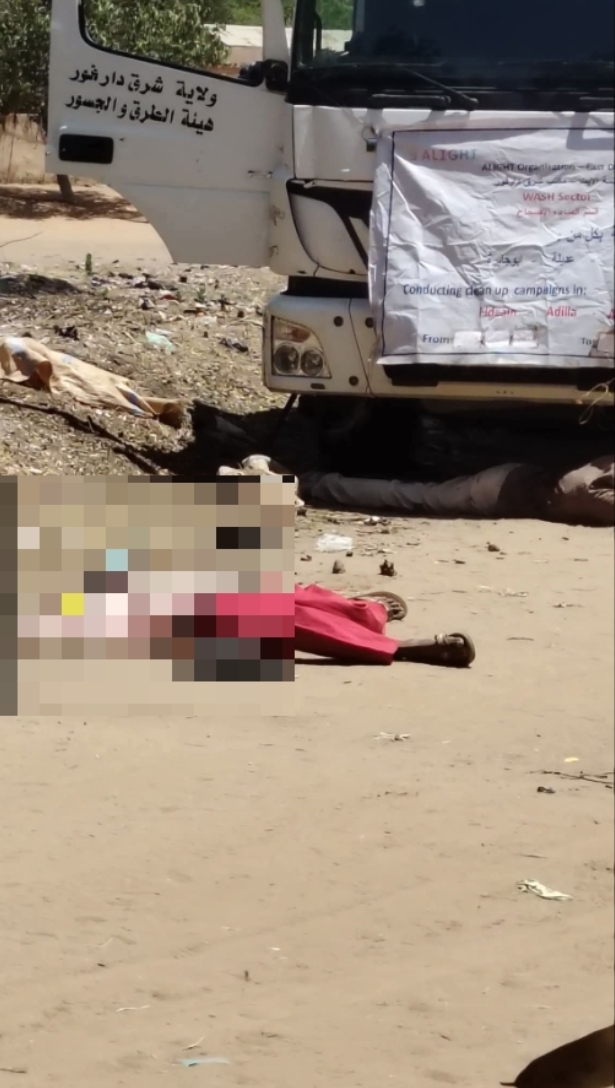
On Monday, 13 April 2026, and based on field investigations conducted by Darfur Victims Support, a drone strike carried out by the Sudanese Armed Forces targeted West Market, Al-Nazir neighborhood (near the park), and the area west of the Ministry of Health in Al-Daein, the capital of East Darfur State.
The findings of this report are based on direct interviews with a Ministry of Health official—whose identity has been withheld for security reasons—and three eyewitnesses, in addition to corroborated information from local medical sources. This provided a reasonable level of verification and accuracy regarding the sequence of events.
The attack occurred at approximately 11:10 a.m. Sudan time, while a number of Ministry of Health workers were engaged in a routine cleaning campaign as part of an environmental health program within the market. According to the health official’s testimony, the drone flew at low altitude before launching a projectile toward the gathering. The information collected indicates that there were no signs of armed activity or military presence in the vicinity at the time of the strike, based on available testimonies and evidence.
One eyewitness, Mohamed (38), from Al-Nazir neighborhood, stated:
“We heard a loud explosion, followed by thick smoke. When I reached the scene, I found the victims at their workplace among cleaning tools.”
The attack resulted in the killing of four health sector workers affiliated with the Ministry of Health in East Darfur State:
1. Al-Bashar Al-Sharif Mohamed – Environmental Health Officer
2. Al-Sharif Bashara – Vector Control Officer (Environmental Health)
3. Habib Ibrahim – Environmental Health Assistant
4. Najwa Ibrahim Adam Omar – Health Assistant
Available information indicates that the victims were performing their professional duties and were identifiable as health workers at the time of the attack, reinforcing their civilian status and lack of involvement in any military activity.
This incident cannot be viewed in isolation from a broader pattern observed across various parts of Darfur in recent months. The organization, along with medical and local sources, has documented multiple incidents involving the targeting of civilian gatherings and service facilities through drone strikes or aerial bombardment during working hours and routine daily activities.
These patterns include:
• The targeting of crowded markets during peak daytime activity.
• Strikes occurring in the vicinity of service facilities, including public health-related activities, without evidence of military use.
• Repeated attacks at times characterized by high civilian presence.
Taken together, these incidents raise serious concerns regarding compliance with the principles of distinction, proportionality, and precaution under international humanitarian law. They also reflect a direct cumulative impact on the continuity of essential services, particularly in the health sector, which is already severely strained in conflict-affected areas.
Demands and Recommendations
Accordingly, the organization calls for:
• An independent and transparent investigation into this incident, with the participation of relevant international bodies.
• The expansion of investigations to include recurring patterns of targeting across Darfur.
• Urgent measures to ensure the protection of health personnel and workers in essential service sectors.
• Accountability for those responsible for any violations that are substantiated.
• Fair and prompt support for the families of the victims.
The organization further calls for the activation and effective enforcement of the ban on offensive military flights over the Darfur region, pursuant to United Nations Security Council Resolution 1591 (2005). This includes halting the use of military aircraft and drones in civilian-populated areas as a necessary measure to reduce harm to civilians and protect humanitarian and service infrastructure.